
Article: Bullet Journaling: A Tool to Heal Your Attention Span

Bullet Journaling: A Tool to Heal Your Attention Span
What bullet journaling is
Bullet journaling is an analogue organisation system created by designer Ryder Carroll and published in full in his 2018 book The Bullet Journal Method. A notebook-based practice for capturing tasks, events, and notes, it is built around regular review: the system asks you to look at what you have written, assess it, and decide what to do with it.
Four components form the foundation. An index acts as a running table of contents. A future log stores events and tasks for months ahead. A monthly log brings the near future into focus at the start of each month. A daily log is where most writing is concentrated, running continuously through the notebook with the date as a header.
Holding these together is rapid logging: a shorthand for recording information quickly using bullets for tasks, dashes for notes, and circles for events. A completed task gets an X. A task carried forward gets an arrow. Something struck through is no longer relevant. The notation takes about ten minutes to learn.
On top of this foundation, practitioners add collections: pages dedicated to a specific subject (a reading list, a habit tracker, and notes on a project). Collections are where one can fine-tune the system, and, apparently, the section that confuses most of the writers.
The problem it was designed to solve
Carroll developed the system over years of managing his own attention deficit disorder. The problem he was solving was put like this: how to stay clear and intentional in a world that generates more information, tasks, and demands on attention than any person can comfortably hold.
His argument about digital tools is worth understanding before picking up a notebook. Notifications, infinite scroll, the frictionless addition of new tasks: these features of digital productivity systems encourage accumulation over discernment. A notebook cannot notify you. It cannot add items without you choosing to write them. Every entry requires a small, conscious act.
Carroll frames the bullet journal as a practice of intentional attention, asking one question repeatedly at each weekly and monthly review: Does this deserve to be here? Tasks that get migrated from day to day without completion create a mild friction by design. If something is not worth rewriting, it is probably not worth doing.
Holding that question in mind before setting up a single page matters more than any choice of layout or collection. The spreads follow from the thinking; they do not produce it.
The core system looks like this
Carroll's system requires very little to begin: a notebook, a pen, and familiarity with four components.
Rapid logging uses a dot to mark tasks, a dash for notes, and a circle for events. A completed task gets an X through its dot. A task migrated forward gets an arrow. A task no longer relevant gets struck through. This notation serves as the common language across every page in the notebook.
The index is a list of contents, updated as new pages are added. Page numbers are written in from the start, or added as you go. The future log covers the months ahead, typically six at a time, with a small section for each. Events and tasks belonging to a future month are recorded here and transferred to the monthly log when that month arrives.
The monthly log opens each new month with two facing pages: one for a calendar view, one for a task list. The daily log runs continuously from there, with each day beginning wherever the previous one ended.
That is the complete original system. Many practitioners add considerably more. Whether they should is what the next section is about.

Why templates are a trap
Search for bullet journal ideas online, and you will find thousands of spreads: pages for tracking habits, moods, finances, sleep, water intake, books read, films watched, gratitude, goals etc. Many are beautifully made. Most will not help you.
Copying a spread skips the only part of the process that makes it useful: deciding whether you need it. A habit tracker has value if you are genuinely trying to build or monitor a habit, and if reviewing it weekly will change your behaviour. Filled in for a fortnight and then abandoned, it is just a waste of attention.
Carroll is explicit about this in his book. Collections that work appear from real needs, identified through reflection. A spread copied from Instagram reflects someone else's needs and someone else's thinking. It may look organised. Yet, it is organised for someone else’s mind.
The overwhelm that many people feel when starting comes from this mismatch: too many options, too much visual inspiration, no framework for deciding what actually belongs in their notebook. Adding more content does not resolve that. Starting with the core system only, for a full month, and letting collections form from genuine friction, from the things you keep forgetting or the information you wish you had in one place, produces a notebook that is actually used.
A spread designed around your own question, however simple, will serve you better than the most beautiful template you found online. Asking the question is a portion of the work.
How to decide what to track
Before adding any collection, three questions are worth sitting with.
What problem am I trying to solve? A collection should exist in response to something: a recurring feeling of disorganisation in a particular area, information that is currently scattered, a habit that is not forming. If the honest answer is that a page looks appealing but there is no underlying friction, the collection is decorative. There is nothing wrong with decoration, but it is worth knowing which is which.
Will reviewing this change anything? A tracker earns its space only if looking at it causes you to act differently. A mood tracker reviewed weekly might reveal patterns worth understanding. The same tracker never looked at is just a record. The review is the point.
How simple can this be? Collections tend to expand toward complexity over time. The more elaborate a spread, the higher the maintenance cost, and the more likely it is to be abandoned when life becomes busy. Starting with the minimum version and adding to it only when the minimum proves insufficient is a reasonable rule for almost any collection.
These questions do not produce a list of what to track. They produce a way of thinking that applies to any subject. That is the intention: the collections are the output of reflection, not the input.
Why people stop, and what it means
Most people who try bullet journaling and abandon it describe the same sequence: an enthusiastic start, a period of consistent use, a gap, then guilt about the gap, then not returning. The notebook sits on the desk as a mild reproach.
Stopping usually signals that the system being used was not quite the right one, or had accumulated more complexity than the practice could sustain in busier periods. A bullet journal built around borrowed collections requires more maintenance than one built around genuine needs. When life accelerates, the borrowed parts fall away first, and the remaining system no longer feels coherent.
Returning to the minimum is more useful than starting a new notebook with renewed commitment. Daily log, monthly log, nothing else, for two or three weeks. The collections worth having make themselves known by their absence, by the things you find yourself wanting to note but having nowhere to put.
Picking up a neglected journal mid-month is also entirely possible. Carroll's system has no requirement for continuity of form. Open to a new page, write today's date, and begin.
What you actually need to start
A notebook with numbered pages, or one you are willing to number yourself. A pen that writes consistently and that you are comfortable using for extended periods. Nothing else is required.
The notebook does not need to be dotted, though many people find a dot grid more versatile than lines for mixing written entries with simple layouts. Size is a matter of how and where you write: A5 is the most commonly used format, large enough for comfortable writing, portable enough to carry. Price matters less than feel. A notebook that looks too precious to write in imperfectly is the wrong notebook.
The bullet journal will contain crossed-out tasks, abandoned collections, and days recorded in two lines. A notebook that invites that kind of use, that does not resist being opened and marked and moved on from, is the right one.
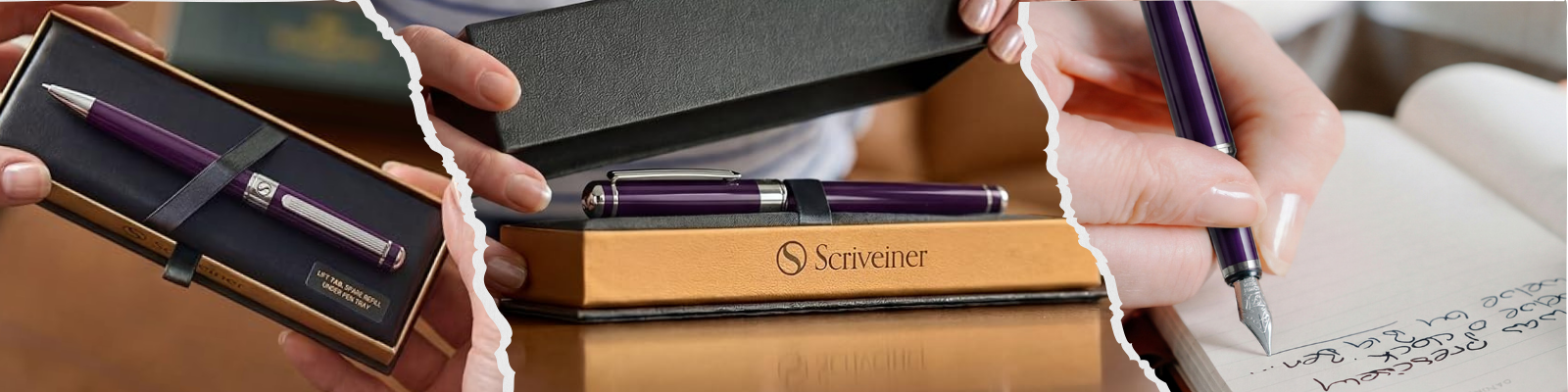
Scriveiner makes pens designed for daily use, in three writing modes. We believe a beautifully working rollerball pen is something that will accompany a Bullet Journal easily. Minimalist vintage aesthetic is rooted in Britain’s penmaking tradition; the writing core is manufactured by the company, trusted by other leading European penmakers. The full range is here.

Leave a comment
This site is protected by hCaptcha and the hCaptcha Privacy Policy and Terms of Service apply.